Games for children · iPhone & iPad
Games a child can play alone
Five puzzle games for ages 4 to 10. Every level is designed by hand and checked by a solver. No advertising, nothing collected, nothing to read.
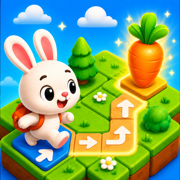
Ages 5–10 · Coding
AlgoForKids
Show the rabbit the way
Children build a plan out of picture blocks and watch a rabbit follow it — sequencing, loops and functions, met before any code is written.
100 · levels, hand-designed
Open AlgoForKids
Ages 4–10 · Maths
Pomki
Algebra, met as a puzzle
Fruit on a market scale teaches counting, then equality, then equations — without a single digit appearing on screen.
120 · levels, hand-made
Open Pomki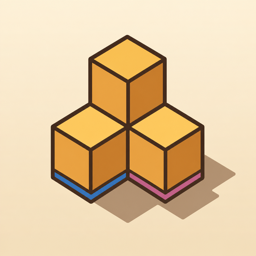
Ages 4–10 · Space
Solki
Look at the shadow, see the solid
Three flat views — front, side and top — and one shape that fits all three. Children build it with cubes, and learn to think in three dimensions.
168 · levels, hand-made
Open Solki
Ages 4–10 · Mechanism
Torki
Build machines that turn
A crank turns on the left. A machine on the right needs to turn. Your child fills the workbench with gears until the movement arrives — and meets ratios years before the word.
160 · levels, hand-made
Open Torki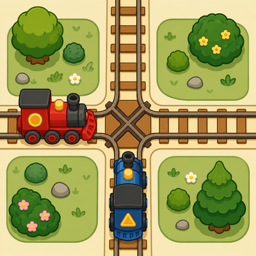
Ages 4–10 · Timing
Lokki
Keep the trains running
Trains circle a shunting yard and the track has gaps. Your child fills them, sets the switches, and learns the one thing every railway has to solve: not being in the same place at the same time.
150 · levels, verified
Open LokkiThe same four promises in every game
These are not features we might trade away later. They are the reason the games are built the way they are.
No advertising
Not banners, not videos, not “rewarded” ads. Nothing tries to move your child’s attention somewhere else.
Nothing collected
No analytics, no tracking, no identifiers, no accounts. None of them contains any networking code at all.
No permissions
Camera, microphone, location, notifications — none are requested, because none are needed.
One purchase, gated
A generous free section, then a single optional purchase behind a parental gate. Never a subscription.
Hand-made, then proved
Procedural generation was tried early on and thrown away — it produced levels that were technically different and practically identical. Every level is drawn by hand, then a solver plays it and proves it can be finished, that its solution is unlike any other level’s, and that the three-star target is genuinely reachable. Difficulty is measured, not guessed.
A real person answers
Questions, bug reports, refund help. Write in any of our four languages.