 Solki
Solki
 AlgoForKids
 Pomki
Pomki
 Torki
Torki
 Lokki
Lokki
For ages 4–10 · iPhone & iPad
Look at the shadow, see the solid
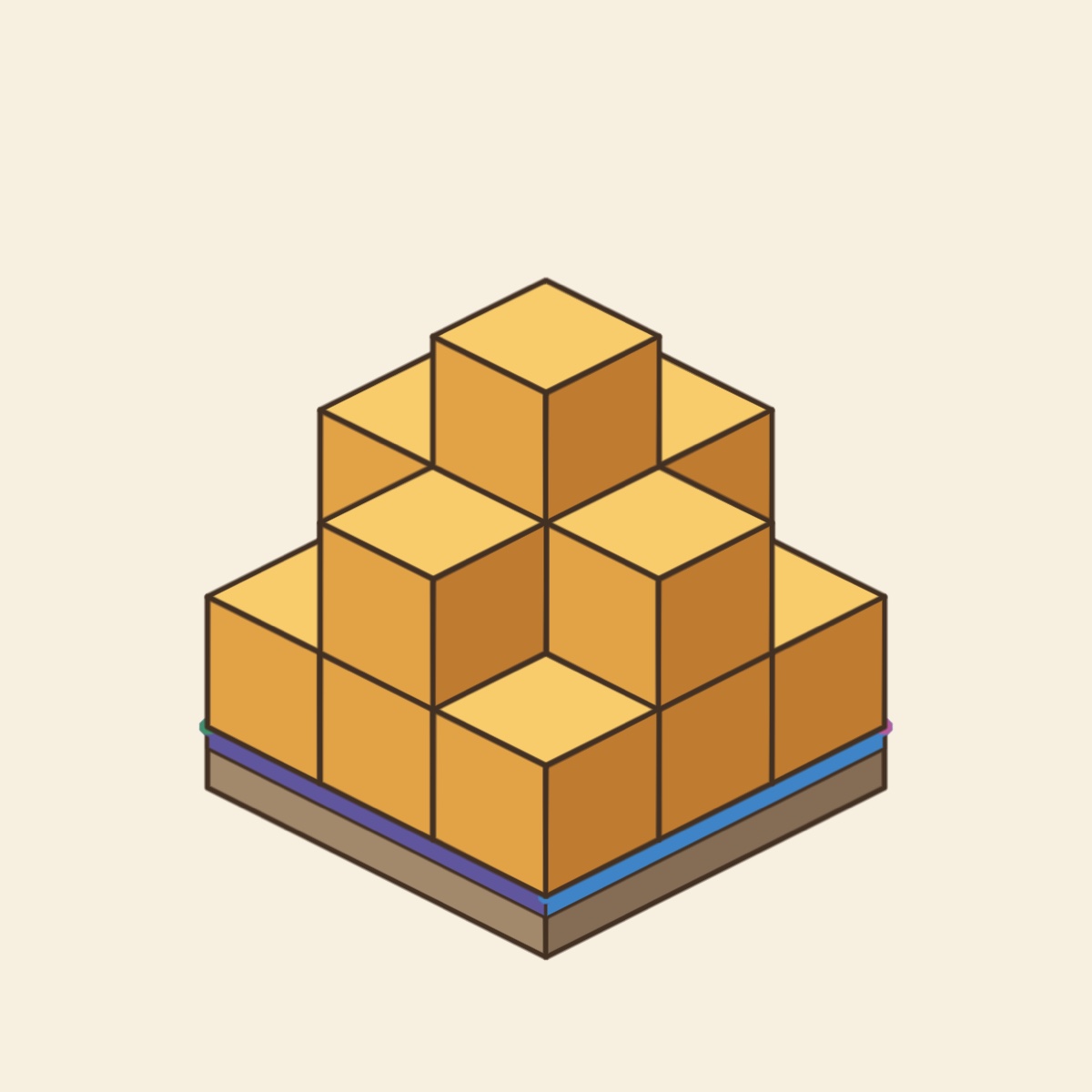
An isometric workbench and one kind of cube. Three cards show what the shape looks like from the front, from the side and from above — your child builds the solid that casts all three shadows at once.
- 168 hand-made levels
- First 20 free
- No ads, ever
The quiet part matters
A game a four-year-old plays alone should not be a place where anything is being sold, measured or collected.
No advertising
Not banners, not videos, not “rewarded” ads. There is nothing in this game trying to get your child’s attention somewhere else.
No data collection
No analytics, no tracking, no identifiers. We do not know who plays, when, or for how long — by design.
Works offline
The app contains no networking code at all. It plays on a plane, in a car, on a tablet with no SIM.
One purchase, behind a gate
The first 20 levels are free — a complete world on its own. Unlocking the rest is one purchase, behind a parental gate.
Three steps, every level
The loop is always the same, so the child’s attention goes to the shape instead of the interface.
-
1 Tap
Drop a cube
Touch a square on the workbench and a cube falls onto the top of that column. One gesture. Nothing to drag, nothing to aim.
-
2 Read
The cards answer
All three shadow cards update as you build. Cells that match fill in, missing cells are dashed, extra cells are hatched — the game says what is wrong without saying a word.
-
3 Turn
Look from the other side
One button rotates the workbench a quarter turn, so the cubes hiding behind other cubes come within reach. Tap a cube to take it back.
What a child actually learns
Three worlds, one workbench. Each world is a real spatial idea the puzzles make you use.
Shadow and solid
A flat picture and a three-dimensional thing are not the same, and one comes from the other. The first world is that single idea, twenty-something levels long.
Height
A row of columns seen from the front is a bar chart. Children raise each column to the right height years before anyone calls it a graph.
Two rules at once
Satisfying the top card is easy. Satisfying the top and the front together is a different kind of thinking — and then there are three.
Plan and elevation
Reading a view from above and a view from the side is exactly what engineers, architects and surgeons do. Here it is a game.
Fewest cubes
From age eight the question flips: dozens of shapes cast the same three shadows, so find the one that uses the fewest cubes. That is optimisation, met without the word.
Every level made by hand
Procedural generation was tried on an earlier game and thrown away: it produced levels that were technically different and practically identical.
All 168 levels were designed by hand, then checked by a solver that proves three things — the level can be solved, no two levels are the same puzzle, and the three-star target really is the fewest cubes the shape can be built with. That last number is not a guess: the solver searches the whole space and returns the minimum. Difficulty was measured rather than estimated, so the curve rises smoothly instead of jumping.
- 168
- levels, hand-made
- 20
- free to play
- 3
- worlds, one mechanic
- 4
- languages
What is on the workbench
One cube and three cards. There is nothing to read, no numbers and no symbols anywhere in the game.
The cube
One kind, one colour, one size. Colour carries no meaning here — the puzzle is made of shape and height, which is also why colour blindness costs nothing.
The workbench
A square grid the cubes stand on. All four of its vertical edges are coloured, so whichever way you turn it, the visible edges still say which side is which.
The front card
What the shape looks like from the blue edge. Its frame is blue, and its cells are slanted like the face they describe.
The side card
The same from the plum edge. Front and side are the two your child has to hold in mind together.
The top card
The view from above — a diamond, because that is the shape of the workbench seen from the top. Never a flat square.
Layers
In the third world gravity is off and cubes float. A layer picker chooses which storey you are building on; the ones below are drawn faint.
Questions parents ask
Does my child need to read?
No. There is no text in the game and no numbers either. Everything is shown by the cards and the cubes themselves.
My child is four. Is it too hard?
No. The first world has a single card and a single rule — copy the shadow. Cubes fall into place on their own, so the whole game is one tap. The free section is exactly that world.
Is this really a maths game?
It is a spatial reasoning game, and spatial reasoning is the part of mathematics that shows up in maps, diagrams, drawing and geometry. By the third world it is also optimisation: find the answer that uses the fewest cubes.
How much does it cost?
The app is free and the first 20 levels are free to play. Unlocking the remaining 148 is one single purchase — not a subscription, and there is nothing else to buy.
Can my child buy something by accident?
No. The purchase screen is behind a parental gate that a young child will not pass. Apple’s own payment sheet then asks for Face ID or a password.
Can my child get stuck or lose?
There is no way to lose and no timer. A wrong cube is not a mistake, just a hatched cell on a card; tap it and it comes back. Nothing is ever lost.
Is there any advertising?
None. There is no advertising code in the app at all, and there never will be.
Which devices does it run on?
iPhone and iPad running iOS 16.6 or later, in English, Turkish, German and Spanish.
Ready when they are
Twenty levels are free — the whole first world. That is enough to know whether your child likes it.
iPhone and iPad · iOS 16.6 or later · No ads · No data collected