 Lokki
Lokki
 AlgoForKids
 Pomki
Pomki
 Solki
Solki
 Torki
Torki
For ages 4–10 · iPhone & iPad
Keep the trains running
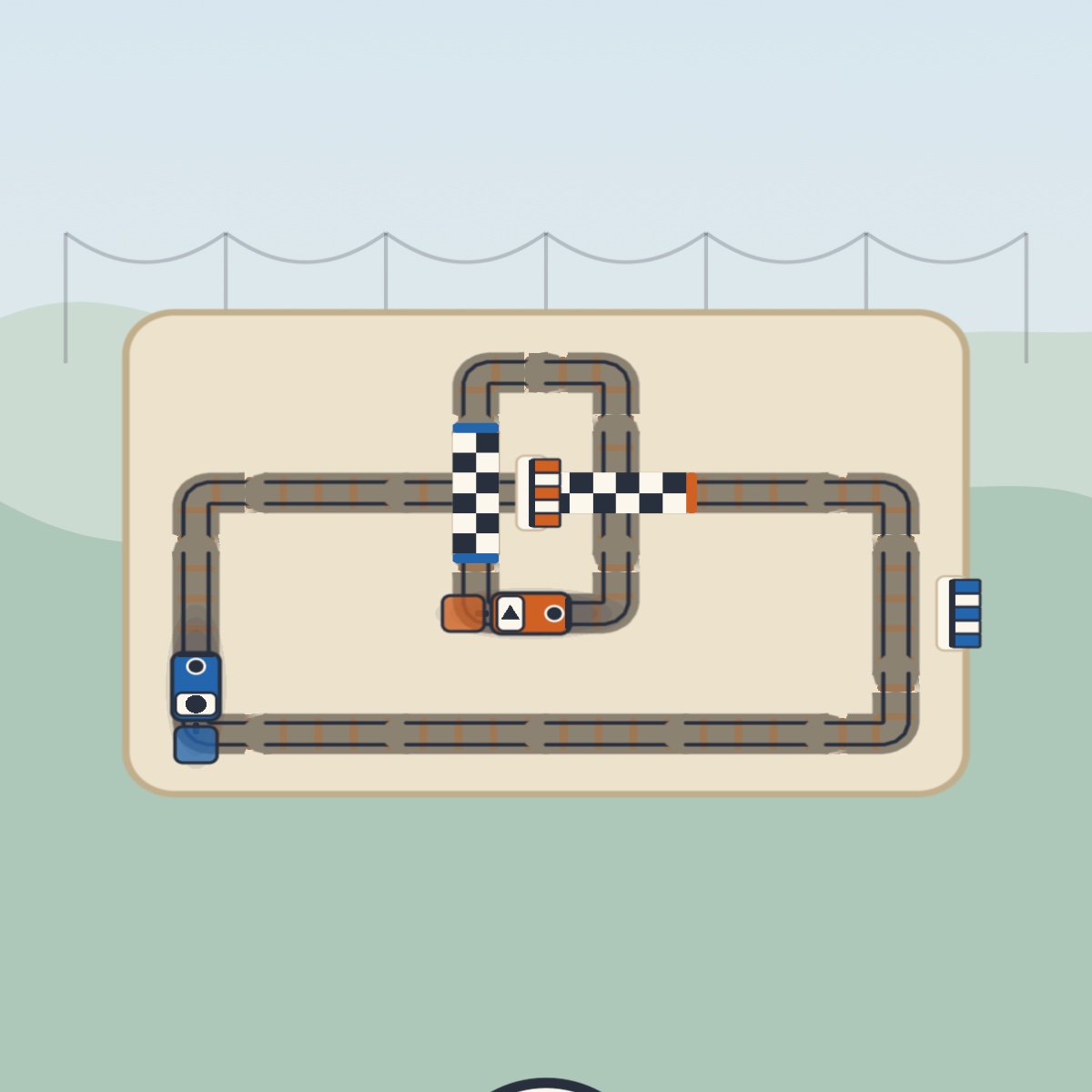
A yard that is already moving, gaps in the track, and a tray with three kinds of rail. Your child taps a gap and the train sets off — and when two trains reach the same rail at the same moment, both stop and the real puzzle begins.
- 150 verified levels
- First 20 free
- No ads, ever
The quiet part matters
A game a four-year-old plays alone should not be a place where anything is being sold, measured or collected.
No advertising
Not banners, not videos, not “rewarded” ads. There is nothing in this game trying to get your child’s attention somewhere else.
No data collection
No analytics, no tracking, no identifiers. We do not know who plays, when, or for how long — by design.
Works offline
The app contains no networking code at all. It plays on a plane, in a car, on a tablet with no SIM.
One purchase, behind a gate
The first 20 levels are free — a complete world on its own. Unlocking the rest is one purchase, behind a parental gate.
Three steps, every level
The loop is always the same, so the child’s attention goes to the trains instead of the interface.
-
1 Pick
Choose a piece
Three kinds of rail sit in the tray, and each one shows what it does: a tiny train crosses the plain rail in one beat and the curly one in two. One tap picks a piece. Nothing is dragged.
-
2 Tap
Fill a gap
Touch a dashed gap and the piece drops into it. The gaps show which way they will connect, so nothing has to be rotated or aimed.
-
3 Watch
The yard answers
There is no start button — the trains are already moving. They run, or two of them meet and stop. Tap a piece to lift it off and try another kind.
What a child actually learns
Three worlds, one yard. Each world adds one real idea about time — and the puzzles make the child use it.
Continuity
A train goes where the track goes and never reverses. The first world is that single sentence: close the gaps, and the train runs because the loop is whole.
Choosing a route
A switch decides which way a train turns. The closed branch shows a striped barrier and the open one is clear, so the choice is visible before the train arrives — not a guess.
Simultaneity
Two trains cannot be on the same piece. If they arrive at once, both stop — there is no referee and no right of way, because a rule a child cannot see on screen is a rule we did not write.
Waiting is not failing
A train that waits for a busy rail has not lost. The only real problem is a jam, and a jam is fixed by making one train arrive a turn later.
Common multiples
In the third world two separate loops cross. A lap of 14 and a lap of 6 meet at the crossing every 42 turns; make one lap 15 and they never meet again. Multiples, before multiplication.
Every level verified
Procedural generation was tried on an earlier game and thrown away: it produced levels that were technically different and practically identical.
All 150 levels were searched for and then verified by a solver that proves four things — the level can be solved, no two levels are the same puzzle, the three-star target really is the fewest pieces, and the level can still go wrong. That last check is the important one: if closing every gap were enough, the level would not be teaching timing at all, and it is dropped. The solver works in whole numbers — every train moves one piece per turn and the system is periodic, so “it runs forever” is proved rather than assumed. Difficulty was measured rather than estimated, and the campaign is ordered by lesson: close the track, choose the route, do not overbuild, then timing and laps.
- 150
- levels, verified
- 20
- free to play
- 3
- worlds, one mechanic
- 4
- languages
What is on the yard
Three kinds of rail and three fixed parts. There is nothing to read, no numbers and no symbols anywhere in the game.
Track
The plain piece: a train crosses it in one turn. Most gaps want nothing else, and most of a solution is track.
The loop
A curly piece that joins the same two ends but takes two turns to cross. This is how a train is delayed without any speed setting existing anywhere in the game — and it is what unjams a junction.
The passing pocket
The one piece where two trains fit side by side. Two trains meeting head-on in a single-track stretch can only pass here.
The switch
Drawn like the knife switch in a circuit: a pivot, a blade and two contacts. The branch the train will not take is closed by a striped barrier, and a green arrow shows where it will go.
The crossing
Two lines crossing without joining, exactly as on a real railway. Only one train fits, so two separate loops that cross must be timed against each other — the whole third world lives here.
The stop
A platform with a striped canopy and a passenger waiting under it, marked with the same shape as the train that serves it. The train passes, the passenger boards.
Questions parents ask
Does my child need to read?
No. There is no text in the yard and no numbers either. What a piece does is shown by a tiny train crossing it in the tray; where a train will go is shown by the switch and a barrier.
My child is four. Is it too hard?
No. The first world has one rule — close the gap and the train runs — and one gesture: pick a piece, tap a gap. Nothing is timed and nothing can be lost. The free section is exactly that world.
Is this really a maths game?
It is a timing game, and by the third world it is an arithmetic one: to keep two crossing loops apart forever your child has to change how long a lap takes. Common multiples arrive as trains, years before they arrive as notation.
How much does it cost?
The app is free and the first 20 levels are free to play. Unlocking the remaining 130 is one single purchase — not a subscription, and there is nothing else to buy.
Can my child buy something by accident?
No. The purchase screen is behind a parental gate that a young child will not pass. Apple’s own payment sheet then asks for Face ID or a password.
Can my child get stuck or lose?
There is no way to lose and no timer. A wrong piece is not a mistake — tap it and it comes off. Even a jam is not a failure; it is what happens on a real railway when two trains want the same rail.
Is there any advertising?
None. There is no advertising code in the app at all, and there never will be.
Which devices does it run on?
iPhone and iPad running iOS 16.6 or later, in English, Turkish, German and Spanish.
Ready when they are
Twenty levels are free — the whole first world. That is enough to know whether your child likes it.
iPhone and iPad · iOS 16.6 or later · No ads · No data collected