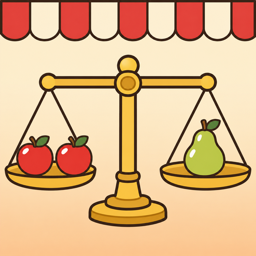
 Pomki
Pomki
 AlgoForKids
 Solki
Solki
 Torki
Torki
 Lokki
Lokki
For ages 4–10 · iPhone & iPad
Algebra, met as a puzzle
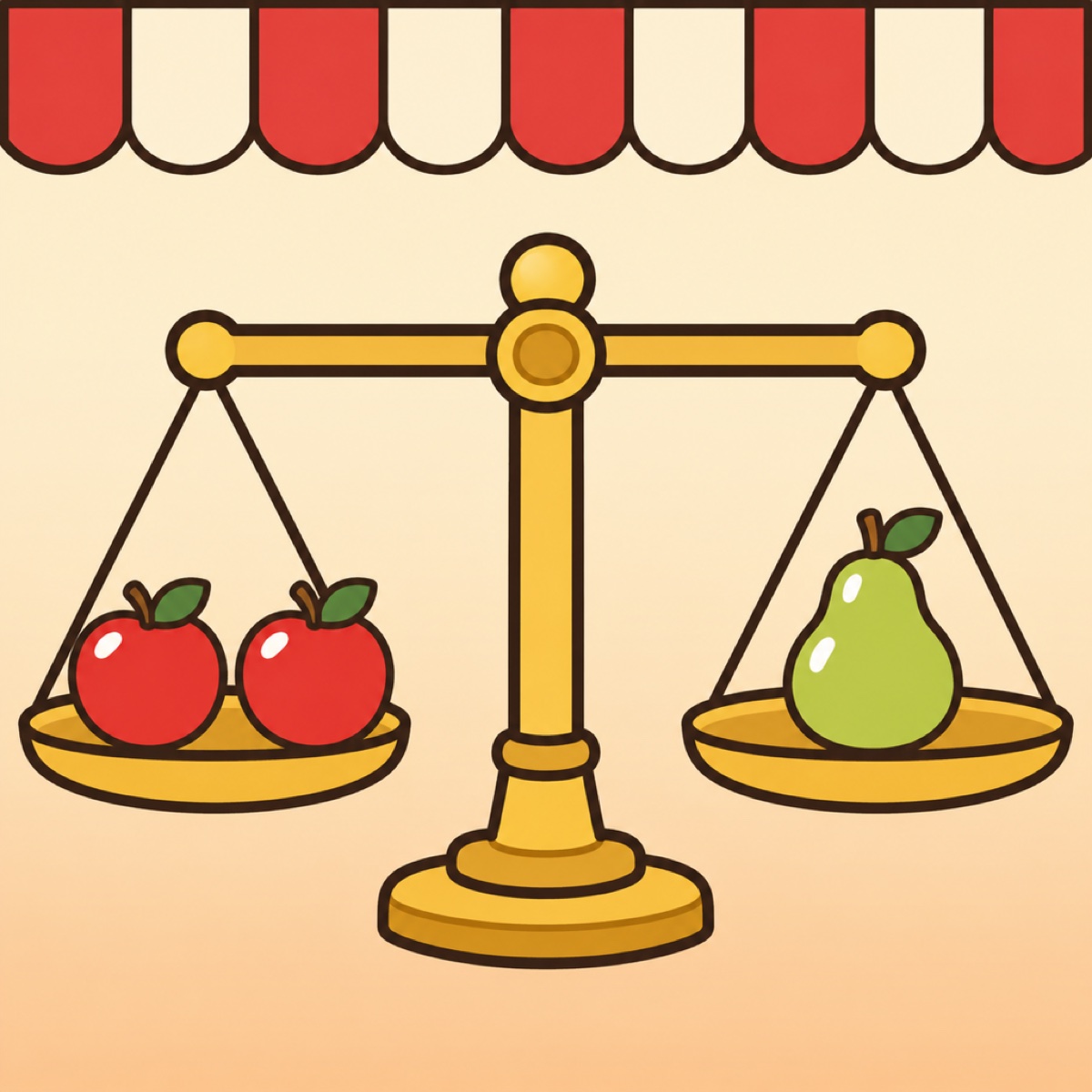
A market stall, a two-pan scale and fruit that gets heavier as it gets bigger. Children balance the pans with their fingers — and by the last levels they are solving equations without ever meeting the letter x.
- 120 hand-made levels
- First 20 free
- No ads, ever
The quiet part matters
A game a four-year-old plays alone should not be a place where anything is being sold, measured or collected.
No advertising
Not banners, not videos, not “rewarded” ads. There is nothing in this game trying to get your child’s attention somewhere else.
No data collection
No analytics, no tracking, no identifiers. We do not know who plays, when, or for how long — by design.
Works offline
The app contains no networking code at all. It plays on a plane, in a car, on a tablet with no SIM.
One purchase, behind a gate
The first 20 levels are free — a complete world on its own. Unlocking the rest is one purchase, behind a parental gate.
Three steps, every level
The loop is always the same, so the child’s attention goes to the puzzle instead of the interface.
-
1 Place
Drag the fruit
Take apples, pears, melons and pumpkins from the tray and drop them onto either pan. Bigger fruit is heavier — the picture says so.
-
2 Watch
The scale answers
The pans tilt by exactly the difference. Too heavy on the left and the left goes down; there is no other feedback to read.
-
3 Adjust
Take it back
Nothing is lost by a wrong piece. Pick it up again, try another. The level ends when both sides sit level.
What a child actually learns
Three worlds, one mechanic. Each world is a real mathematical idea the puzzles make you use.
Comparison
Which side is heavier? The first world is one-to-one matching and “more than / less than”, for ages four and five.
Equality
Make both sides the same. Addition without symbols, and the discovery that three apples and one melon can be the same weight.
Decomposition
A pumpkin is five. It is also two and three. Breaking a number apart and rebuilding it another way is the whole second world.
The unknown
A closed sack with a question mark. Every sack of the same colour holds exactly the same thing — the game enforces the rule rather than explaining it.
Equations
Two sacks and an apple on one side, seven apples on the other. That is 2x + 1 = 7, solved with fingers before it is ever written down.
Every level made by hand
Procedural generation was tried first and thrown away: it produced levels that were technically different and practically identical.
All 120 levels were designed by hand, then checked by a solver that proves four things — the level can be solved, the sack has exactly one possible value, the three-star target really is the fewest moves possible, and no two levels are the same puzzle. Difficulty was not guessed either: levels are ordered by measured solution length, so the curve rises smoothly instead of jumping.
- 120
- levels, hand-made
- 20
- free to play
- 3
- worlds, one mechanic
- 4
- languages
What sits on the pans
Four fruits and a sack. Weight is legible from the picture — nothing to read, no digits anywhere.
Apple
The unit. Everything else is measured in apples.
Pear
Two apples. The first time a single piece stands for more than one.
Melon
Three apples. Heavy enough that swapping it for three apples feels like a discovery.
Pumpkin
Five apples. The largest known weight, and the one that makes decomposition worth doing.
Sack
A closed bag with a question mark. Its weight is whatever you put inside it.
Same colour, same contents
Fill one red sack and every red sack fills with it. This single rule is algebra’s first principle.
Questions parents ask
Does my child need to read?
No. There is no text in the game and no digits either. Weight is shown by the size of the fruit and by which way the scale tips.
Is this really algebra?
By the third world, yes. Two identical sacks plus one apple balanced against seven apples is 2x + 1 = 7. The child solves it by filling the sacks, which is exactly what solving for x means.
My child is four. Is it too hard?
No. The first world is pure comparison — which side is heavier — and it is twenty levels long. A four-year-old can finish it without help, and the free section is exactly that world.
How much does it cost?
The app is free and the first 20 levels are free to play. Unlocking the remaining 100 is one single purchase — not a subscription, and there is nothing else to buy.
Can my child buy something by accident?
No. The purchase screen is behind a parental gate: a multiplication question that a young child will not pass. Apple’s own payment sheet then asks for Face ID or a password.
Is there any advertising?
None. There is no advertising code in the app at all, and there never will be.
Which devices does it run on?
iPhone and iPad running iOS 16.6 or later, in English, Turkish, German and Spanish.
Ready when they are
Twenty levels are free — the whole first world. That is enough to know whether your child likes it.
iPhone and iPad · iOS 16.6 or later · No ads · No data collected